
The way Free Spins Work in Modern Slots

Free spins have become the centerpiece of modern slot design, converting a simple reel spin into a layered bonus experience. As opposed to handing out a handful of extra turns, today’s free spin rounds integrate multipliers, expanding symbols, and retrigger mechanics that can dramatically alter a session’s outcome. We notice this clearly in titles like Chicken Cross Game, where the free spins feature is not an afterthought but the main event. Grasping exactly how these rounds are built, triggered, and optimised offers us a sharper lens for evaluating any slot. In this article we explain the concrete mechanics that govern free spins, using Chicken Cross Game as a practical reference point without wandering into operator-level details.
The Core Mechanics Behind Free Spin Triggers
At their core, free spins trigger when a specific combination of scatter symbols lands anywhere on the reels. In Chicken Cross Game, the golden egg scatter pays anywhere, and three, four, or five of them award a fixed number of free spins. The number of triggering symbols generally determines the initial spin count: three could grant ten spins, four fifteen, and five twenty. We always check the paytable to confirm exact thresholds, because a game requiring four scatters for a modest ten spins feels very different from one that starts with three and offers generous extras. The scatter’s behaviour during the base game also affects the rhythm of play. Because the golden egg is not required to align on a payline, every spin has the same chance of unlocking the bonus, maintaining anticipation steady.
Some developers include a “scatter boost” where two scatters push a third into place, but Chicken Cross Game follows a straightforward land. This transparency helps players gauge how close they are to a trigger. When scatters also pay a small coin reward for two symbols, a near-miss turns into tangible. Beyond standard scatter triggers, modern slots progressively use collection-based systems or random awards. Chicken Cross Game holds the trigger entirely reel-dependent, so the free spins round can hit on any spin without warning. That suits players who favor sudden volatility over a predictable grind. The game does not include a bonus buy, meaning the only route into the feature is through organic scatter hits, preserving the mathematical integrity of the base game.
Common trigger methods we come across across the market include:
- Scatter anywhere: Symbols pay regardless of position, as in Chicken Cross Game.
- Consecutive reels: Scatters must land on adjacent reels starting from the leftmost.
- Collection meters: Special symbols fill a meter; when full, free spins are awarded.
- Random triggers: The bonus can activate on any spin without a specific symbol combination.
Each approach changes the feel of the base game, and we consider this when contrasting titles.
Symbol Changes and Special Wilds in Bonus Rounds
Free spins rounds often feature symbol actions missing from the main game. In Chicken Cross Game, the most significant change is an spreading wild that occurs only during free spins. Depicted as a fox, it can hit on any of the center three reels and grow to cover the full reel, forming many new winning lines in a one spin. Expanding wilds raise hit occurrence during free spins because they change a single symbol into a full-reel substitute. Together with the 2x global multiplier, a full reel of wilds can generate a significant payout on multiple paylines at once. The fox wild does not carry its personal multiplier, maintaining the bonus round from becoming overly complex.
Some slots also change low-value symbols into big symbols or turn all instances of a chosen symbol into wilds. Chicken Cross Game does not employ a symbol change feature; it concentrates on the expanding wild as the key modifier. This restraint makes it more straightforward to assess the impact of the growing wild on the total return. When a fox hits, we immediately see the reel become full and the win counter rise. Another common modifier is the elimination of low paying symbols during free spins. Chicken Cross Game does not change the symbol set; the same paytable is used in both base game and free spins. The only extras are the spreading wild and the 2x multiplier. This means the typical spin value during free spins is greater than the standard game, but not by a huge amount. The design approach leans toward stability over dramatic swings, which works for players who want to see the complete range of symbols and like the design.
Stake Selection and Tactical Factors for Free Spins Features
Because free spins in Chicken Cross Game are activated by scatter symbols that award anywhere, the bet size we choose does not impact the probability of triggering the round. The random number generator processes each spin on its own, and the scatter hit rate is the same whether we bet the minimum or the maximum. However, bet size determines the absolute value of the free spins round. A 2x multiplier on a maximum bet spin yields a much larger cash return than the same multiplier on a minimum bet. This produces a natural tension: smaller bets lengthen playtime and increase the number of occasions to trigger the bonus, while larger bets magnify the reward when the bonus finally lands. There is no single correct approach; it relies on our session goals and bankroll.
One strategic element we can manage is the determination to continue playing after a free spins round ends. A common misconception is that a slot is “due” for another bonus after a long dry spell, or that it becomes “cold” after a big payout. In Chicken Cross Game, each spin is unrelated, so the odds of triggering free spins remain steady regardless of recent history. Pursuing a bonus by raising the bet size after a losing streak does not boost the probability; it only accelerates the rate at which we deplete the balance. We find it more useful to set a loss limit or a session time limit and treat the free spins feature as a welcome event rather than a target to be forced.
Another practical consideration is the auto-play and turbo spin settings. Many players use these to speed through the base game in search of the bonus round. While this does not change the mathematics, it boosts the number of spins per hour, which can make the volatility appear more intense. In Chicken Cross Game, the base game can deliver long sequences of small wins and losses, so a fast spin speed may result to rapid balance depletion. We recommend modifying the pace to suit our comfort level. The free spins round itself usually plays at a standard speed, and we can often change the animation speed to see the results more quickly. The key is to remember that no setting changes the underlying probabilities.
Multipliers and Boosted Payments During Complimentary Spins
When the free spins round begins, the first thing we examine is whether a multiplier is applied to all wins. In Chicken Cross Game, every win during free spins is subject to a flat 2x multiplier. check this out in essence doubles any payout, converting even a modest line hit into a meaningful contribution. Some slots initiate the multiplier at 1x and raise it with consecutive wins or symbol collections, but Chicken Cross Game maintains it constant, so we do not need to track a climbing meter. That simplicity causes the round easier to read, though it also signifies the feature’s ceiling is set by base symbol values rather than an escalating multiplier that could reach 10x or higher.
Multipliers can also be tied to specific symbols. A common mechanic is a wild that holds a 2x or 3x multiplier when substituting. Chicken Cross Game does not use multiplier wilds during free spins; it uses only the global 2x boost. This design choice holds volatility in check. Combining a global multiplier with multiplier wilds would spike the potential for enormous single-spin wins but also boost dead spins. By sticking to one multiplier layer, Chicken Cross Game produces a free spins round where wins occur at a steadier pace. We recognize that when evaluating long-term behaviour. It is also worth noting how multipliers interact with retriggers. In some slots, each retrigger raises the multiplier by one step. Chicken Cross Game does not raise the multiplier on a retrigger; additional scatters simply add more spins. The 2x multiplier remains fixed, so the feature’s payout potential scales linearly with the number of spins rather than exponentially. For players who prefer to know exactly what each spin is worth, the constant multiplier eliminates guesswork.
Reactivating Free Spins and Extending the Feature
Reactivating allows us to add extra free spins to an active bonus round by hitting the required scatter symbols again. In Chicken Cross Game, obtaining three or more golden egg scatters during free spins awards an additional ten spins, with no upper limit on how many times this can occur. The retrigger uses the same scatter combination as the initial trigger, so the probability of extending the round remains constant. We find that retrigger potential is one of the most important factors in evaluating a free spins feature, because it determines the maximum possible duration of the bonus. A slot that restricts retriggers at one or two extensions will behave very differently from one that permits indefinite retriggers.
The omission of a retrigger cap in Chicken Cross Game implies that, in theory, a single bonus round could run for dozens of spins. In practice, the hit rate for three scatters during free spins is low, so extended sequences are rare. This design creates a wide tail of possible outcomes without making the feature feel impossible to extend. When we analyze a slot, we pay close attention to how often retriggers occur over a large sample. A game that retriggers frequently but awards only a handful of spins each time will produce a different experience than one where retriggers are scarce but award a large block. Chicken Cross Game sits in the middle: ten extra spins per retrigger is a meaningful top-up, and the fixed 2x multiplier pertains to those extra spins as well. Some slots alter retrigger conditions during free spins, for example by demanding only two scatters instead of three. Chicken Cross Game does not change the scatter requirement, so the difficulty remains the same. This consistency makes the maths transparent. We can estimate the expected total free spins from a single trigger by incorporating in the retrigger probability, which typically contributes a modest long-run boost to the feature’s value.
In what manner Free Spins Influence RTP and Volatility
The RTP (RTP) of a slot is a long-term average, and free spins rounds are a significant contributor to that figure. In many modern slots, a significant portion of the overall RTP is centered in the bonus feature. Chicken Cross Game displays its RTP within the game rules, and we can see that the base game returns a lower percentage than the headline figure, with the difference made up by the free spins round. This is a standard structure: the base game gradually provides small wins to hold the balance afloat, while the free spins provide larger, less frequent payouts that push the long-term average toward the stated RTP. Grasping this split helps us set realistic expectations. A session without a free spins trigger will usually run below the theoretical RTP, sometimes well below.
Volatility explains how payouts are spread over time, and free spins features are the principal engine of volatility in slots like Chicken Cross Game. Because the bonus round employs a 2x multiplier and introduces expanding wilds, the likely win size during free spins is considerably higher than in the base game. However, the feature does not trigger frequently. This generates a pattern of small base-game returns interrupted by occasional bonus rounds that can provide a multiple of the total bet. The mix of a fixed multiplier and expanding wilds results in medium-to-high volatility. We do not see the extreme swing potential of a slot with progressive multipliers, but the dry spells between triggers can still be extended.
Various design choices directly shape how free spins affect volatility:
- Multiplier type: Static multipliers produce steadier returns; progressive ones expand the outcome range.
- Retrigger cap: Unlimited retriggers extend the tail of possible results, boosting volatility.
- Symbol removal: Stripping low-paying symbols increases average win size and hit frequency during the bonus.
- Special wild behaviour: Expanding or sticky wilds improve hit rate and can create large clusters of wins.
In Chicken Cross Game, the static multiplier and growing wild lift the hit frequency during free spins, rendering the feature feel more dynamic. This contrast is purposeful; it keeps the bonus round feel rewarding. From a statistical view, the free spins round is the point at which the slot returns the built-up losses of the base game. We consistently suggest reviewing the game’s volatility rating and RTP before betting, because two slots with matching RTP can act very dissimilarly if one directs more of its return into a rare but powerful free spins feature.
Comparing Free Spin Elements Across Modern Slot Releases
While we put Chicken Cross Game alongside other modern slots, its free spins design shines for its clarity. Many popular titles stack multiple modifiers—sticky wilds, symbol upgrades, progressive multipliers, and gamble features—into a single bonus round. Although those can create spectacular highlight-reel wins, they also complicate grasping what is happening on any given spin. Chicken Cross Game employs the opposite approach: a flat multiplier, one type of special wild, and a simple retrigger rule. This establishes it as an excellent reference point for players who want to learn how free spins work without being overwhelmed by cascading mechanics. We can see the core DNA of a free spins feature in its purest form.
This straightforwardness also affects the maximum win potential. Slots with escalating multipliers or unlimited retriggers can offer win caps of 20,000x or more. Chicken Cross Game, with its fixed 2x multiplier and expanding wilds, has a more modest ceiling. The exact maximum win is listed in the game rules, and it generally sits in the range of a few thousand times the bet. For players who prioritise the chance of a life-changing single spin, that may represent a limitation. For those of us who enjoy a slot where the bonus round feels achievable and the outcomes are easier to predict, the lower ceiling is a fair trade-off. It also means the game’s volatility, while present, does not reach the extreme levels of some high-variance competitors.
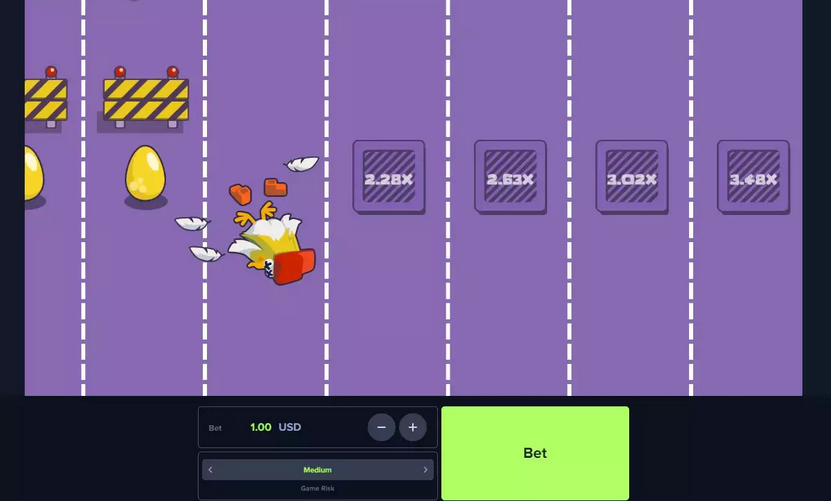
We also consider how the free spins feature fits with the game’s theme. In Chicken Cross Game, the farmyard setting and the fox wild are incorporated into the bonus round in a way that reinforces the narrative. The expanding fox wild suits the idea of a predator scattering the chickens, and the golden egg scatter links directly to the concept of a valuable find. Thematic cohesion in bonus features is not just cosmetic; it makes the mechanics more intuitive. When symbols behave in ways that correspond to their visual identity, we spend less mental energy interpreting the rules and more time savoring the play. This is an underappreciated aspect of free spins design that Chicken Cross Game delivers well.
In the end, the way free spins work in modern slots is a continuum, from minimalist designs like Chicken Cross Game to elaborate multi-tier bonus games. By analyzing the trigger conditions, multiplier structure, special symbol behaviour, retrigger rules, and the overall influence on RTP and volatility, we can move beyond superficial impressions and choose wisely about which games suit our preferences. The next time we open a slot game, we will see beyond the flashy animations and pose the concrete questions this article has outlined. That practice, more than any single tip, is what turns a casual session into a truly strategic one.